
Home / Capabilities / Utility Locating & Survey
Utility Locating & Underground Services Survey in Sydney
Knowing roughly where a service runs is not the same as knowing exactly where it is. Ready Group delivers utility locating and underground services surveys across Sydney and NSW, then confirms critical services by exposing them with non-destructive vacuum excavation. The result is subsurface information you can design and excavate against with confidence.
- Locating to verification in one scope
- QL-A verification by potholing and survey
- Wet and dry vacuum excavation
- ISO 9001, 45001 and 14001 certified
Locating Tells You Where. Potholing Proves It.
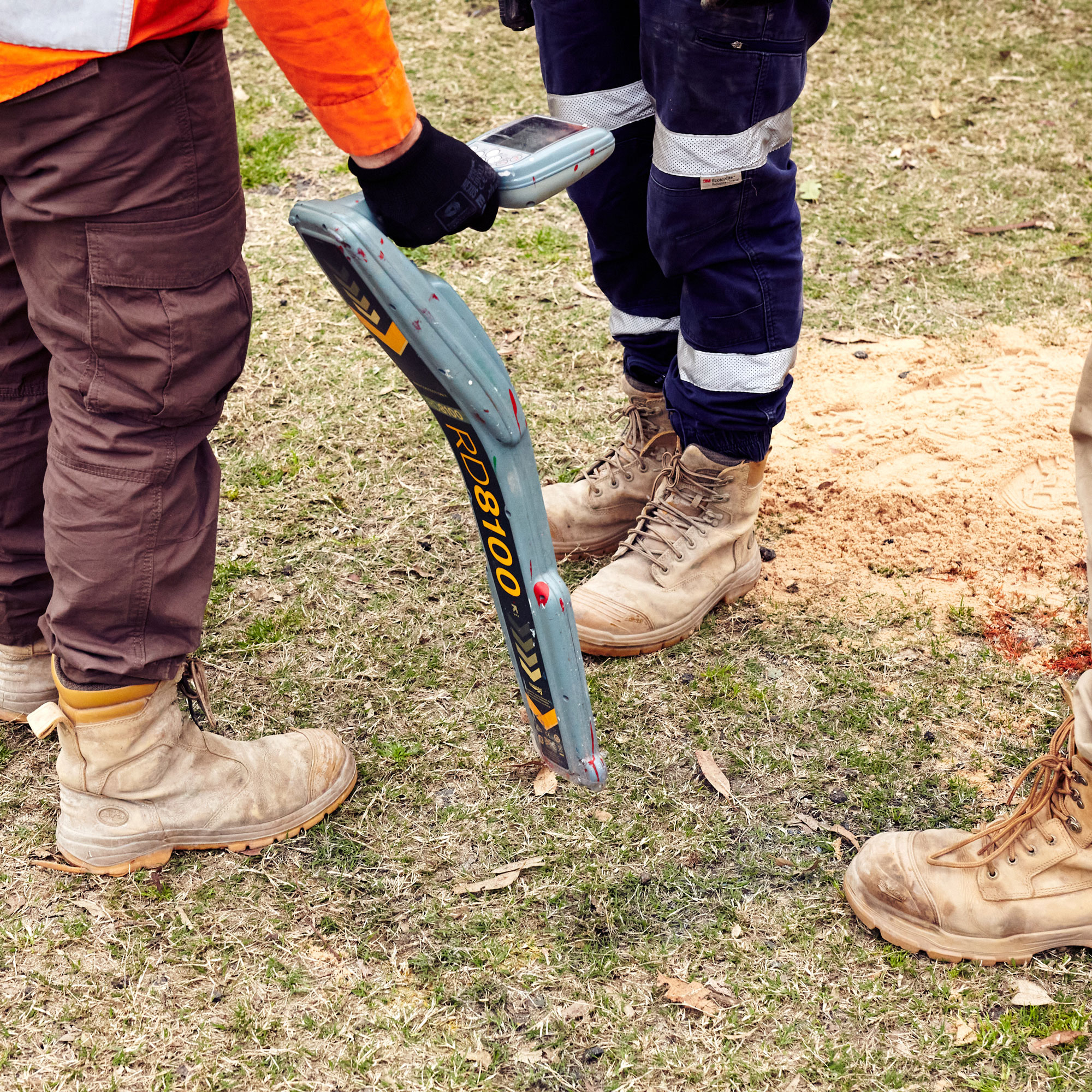
Electromagnetic locating and ground-penetrating radar (GPR) detect buried services from the surface. They are an essential first step, but the position they give is inferred from a signal, not observed. Depth readings in particular can be affected by ground conditions, nearby services and the material being traced.
The only way to verify a service's position is to see it. Non-destructive vacuum excavation exposes the service safely, so its location and depth can be confirmed and recorded before conventional excavation begins.
That is where Ready Group starts. Potholing is carried out with our own plant and our own operators, so locating and verification are delivered under one scope, one booking and one point of accountability.
AS 5488 Quality Levels Explained
AS 5488 is the Australian Standard for classifying subsurface utility information. It grades how reliable information about a buried service is, using four quality levels.
- QL-D: information from existing records, such as Before You Dig Australia (BYDA) plans, or anecdotal sources. A starting point, not a location.
- QL-C: QL-D information correlated with visible surface features such as pits, valves and markers.
- QL-B: services detected and traced from the surface using methods such as electromagnetic locating or GPR. The position is inferred.
- QL-A: the service is physically exposed and its position directly measured and recorded. This is the highest quality level in the standard.
Surface Locating
- QL-D records
- QL-C surface features
- QL-B detected position
With Potholing and Survey
- QL-D records
- QL-C surface features
- QL-B detected position
- QL-A exposed and measured
Where a project needs QL-A information, the service has to be exposed. Exposing live services safely is non-destructive vacuum excavation, the core of what Ready Group does.
How Ready Group Delivers Your Underground Services Survey
- Review the records. We start from current BYDA plans and any site records you hold, so everyone knows what asset owners say is there.
- Locate and mark. We arrange electromagnetic and GPR locating across the work area, with detected services marked on site.
- Pothole to verify. Our operators expose the services that matter to your design or excavation, using wet or dry vacuum excavation to suit the ground and the service.
- Record and report. We coordinate survey of the exposed services and deliver the findings in a format that suits your project.
- Reinstate. Potholes are backfilled and reinstated, with civil reinstatement available where the surface requires it.
We manage the full scope from locating through to verification, so you deal with one contractor instead of coordinating several.

Non-Destructive Potholing, Wet or Dry
Vacuum excavation loosens soil without a bucket or blade and removes it by vacuum, exposing services without the impact that causes strikes. Wet vacuum excavation uses pressurised water and is effective across most ground conditions. Dry vacuum excavation produces dry spoil, which reduces liquid waste and suits sites where water is a problem.
Our Vacvator Metro 6-76 NDD-DRY carries a 7,600 L spoil tank and 3,000 L of water, with a dry vac system, 5 m boom and 270-degree slew. The boom and slew let the operator reach excavation points around obstacles common on Sydney footpaths and road reserves.
See our vacuum trucks and dry vacuum excavation pages for plant details.
Why a Service Strike Matters
A strike on a live service is a safety incident first. Contact with electrical cables or gas mains can cause serious injury or death to workers and the public.
It is also costly. Repairs, outages to homes and businesses, programme delays and the asset owner's recovery costs can all fall on the contractor responsible, alongside any regulatory investigation.
Verifying service positions before you dig is one of the most effective ways to manage that risk.
Safety, Compliance and Accreditation
Our work aligns with the WHS Act 2011, the WHS Regulation 2025 and the SafeWork NSW Excavation Work Code of Practice. It is delivered under ISO 45001 (Work Health and Safety), ISO 9001 (Quality) and ISO 14001 (Environmental) certified management systems.
Our operators are experienced in exposing live services and work to your site requirements and permit conditions. Spoil and liquid waste are transported and disposed of in line with EPA requirements.
Where drains or pipes also need assessing, our CCTV inspections show their internal condition before work begins.
Book Utility Locating in Sydney
Planning excavation, design or a services survey in Sydney or across NSW? Talk to us about locating, potholing and verification for your site.